GTM engineering: what a GTM engineer builds, and when you need one
What GTM engineering is, the 6 systems a GTM engineer builds for software, agencies and e-commerce, one real system start to finish, and how to tell if one would pay for itself.
By Shehriar18 min read
Search "GTM engineering", and nearly every top result sells something. A data tool, a course, a job board or an agency.
Each one answers "do you need what we sell?"
I build these systems for a living, so hold me to the same test. This post also tells you when to pay nobody.
Here's the short answer. GTM engineering is building systems that find, reach and follow up with customers, so nothing depends on memory.
Most small businesses don't need a GTM engineer at first.
They need to switch on what their tools already do. Then 1 or 2 systems, built properly.
What is GTM engineering?#
GTM (go-to-market) engineering is building the machinery behind how a business wins customers. That's the data, the rules and the automations joining them.
A GTM engineer takes a job someone does by hand and turns it into a system.
Researching accounts. Routing a new lead. Chasing a quote. Reminding a shopper about their cart.
Clay, the prospecting data tool, coined the term in 2023. So most definitions describe B2B outbound sales built on Clay.
The idea is wider than that, but it isn't every automation. Switching on your store's abandoned checkout email is automation.
GTM engineering starts when the job crosses tools, needs new data, or needs a rule your tools can't apply.
What does a GTM engineer build?#
6 kinds of system. Each replaces a job that someone does by hand, and drops when they're busy.
| System | The job it replaces | Software or SaaS | Agency or service business | E-commerce |
|---|---|---|---|---|
| Finding | Hunting for prospects and their details | Companies that fit your ICP, with the right contact | Businesses in your niche or area, with a phone and website | Ad audiences built from your best customers |
| Signals | Noticing when someone is ready to buy | Hiring, funding, a new tool on their site | A new location, a new hire, a website relaunch | A product back in stock, a customer's usual reorder date |
| Scoring and routing | Deciding who gets attention first | Good signups sent to a call, the rest to email | Big jobs to you, small ones to a booking link | Wholesale or high-value orders flagged |
| Follow-up | Remembering to reply and chase | A demo request answered in minutes | A quote chased on day 2 and day 7 | Checkout reminders and post-purchase emails |
| Measurement | Knowing what brought each customer | UTM tags plus "how did you hear about us?" | The source of every inquiry, through to the booked job | Orders by channel, tested against a holdout group |
| Data upkeep | Cleaning records nobody trusts | Merge duplicates, close dead deals | A single record per client, every call logged | A single customer record across store, email and support |
Most articles describe Clay-style outbound: the finding, signals and follow-up rows for software. That's a slice of the job, not all of it.
Isn't GTM engineering just RevOps with a new name?#
Mostly, yes. When Bloomberry compared job posts, 9 of the 10 top GTM engineer duties showed up in RevOps engineer posts too.
The usual split: RevOps runs and reports on the sales process. GTM engineering builds new parts for it.
| RevOps | GTM engineering | |
|---|---|---|
| Main job | Run and report on the sales process | Build new systems for it |
| Typical output | Dashboards, CRM rules, forecasts | Data pipelines, automations, AI research steps |
| Judged on | Clean data and accurate forecasts | Hours saved, speed, pipeline the system creates |
In a 10-person business, the label doesn't matter. Both jobs land on one person, usually the founder.
At the earliest stages, founders are often the GTM engineers by default.
What does a GTM system look like, start to finish?#
Here's one I built for Serpint, my SEO and AI-search tool. It's a small software company with no content team and no sales team.
The job: publish useful news posts every week, and turn readers into demo requests. Without me writing every post or chasing every reader.
Most GTM systems have the same 6 parts. Once you can spot them, you can design your own.
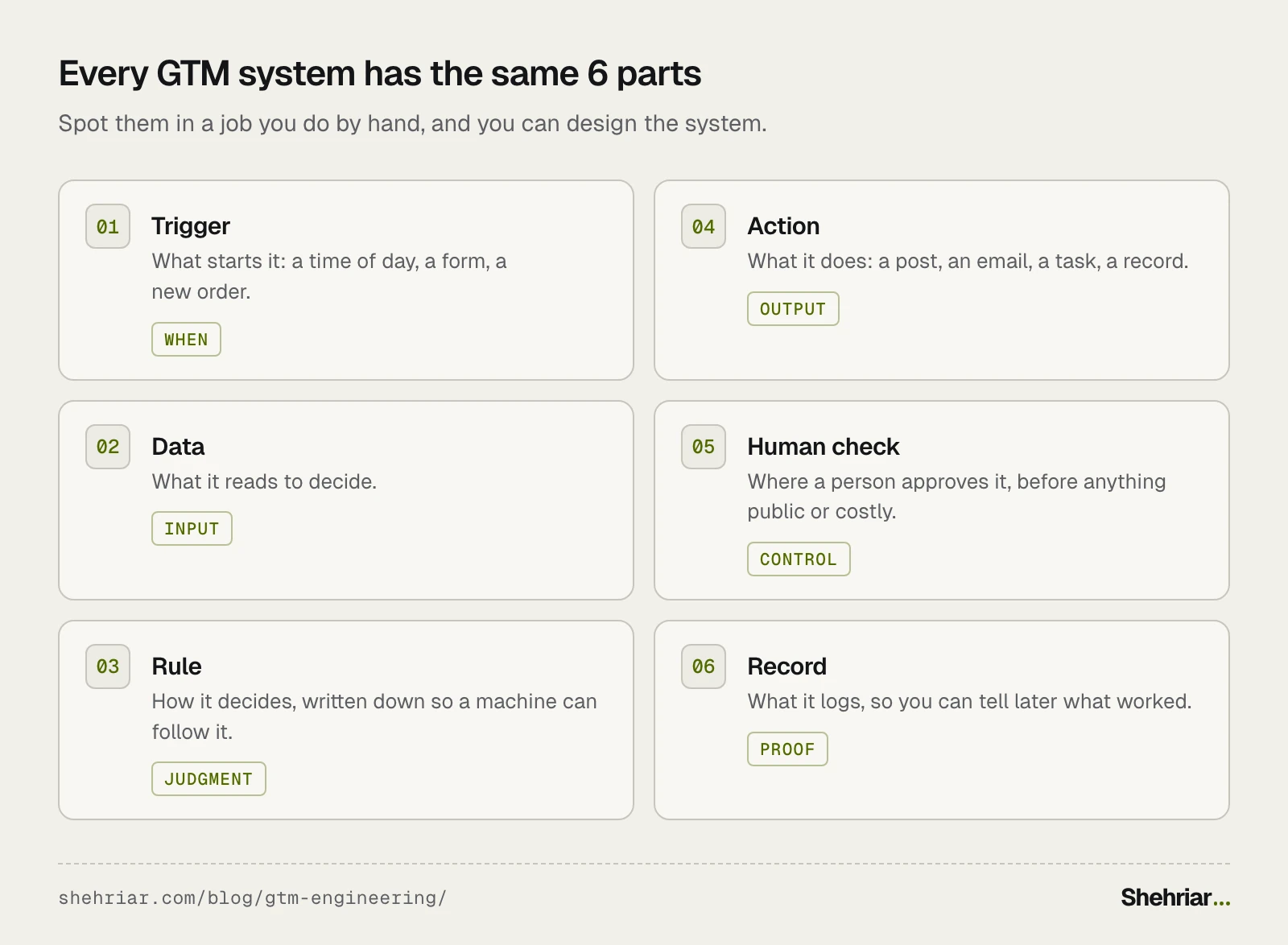
- Trigger: what starts it. A time of day, a form, a new order.
- Data: what it reads to decide.
- Rule: how it decides, written down so a machine can follow it.
- Action: what it does.
- Human check: where a person approves it. Low-risk systems can skip it. Anything public or costly shouldn't.
- Record: what it logs, so you can tell later what worked.
Here's the whole Serpint loop, then each part in turn.
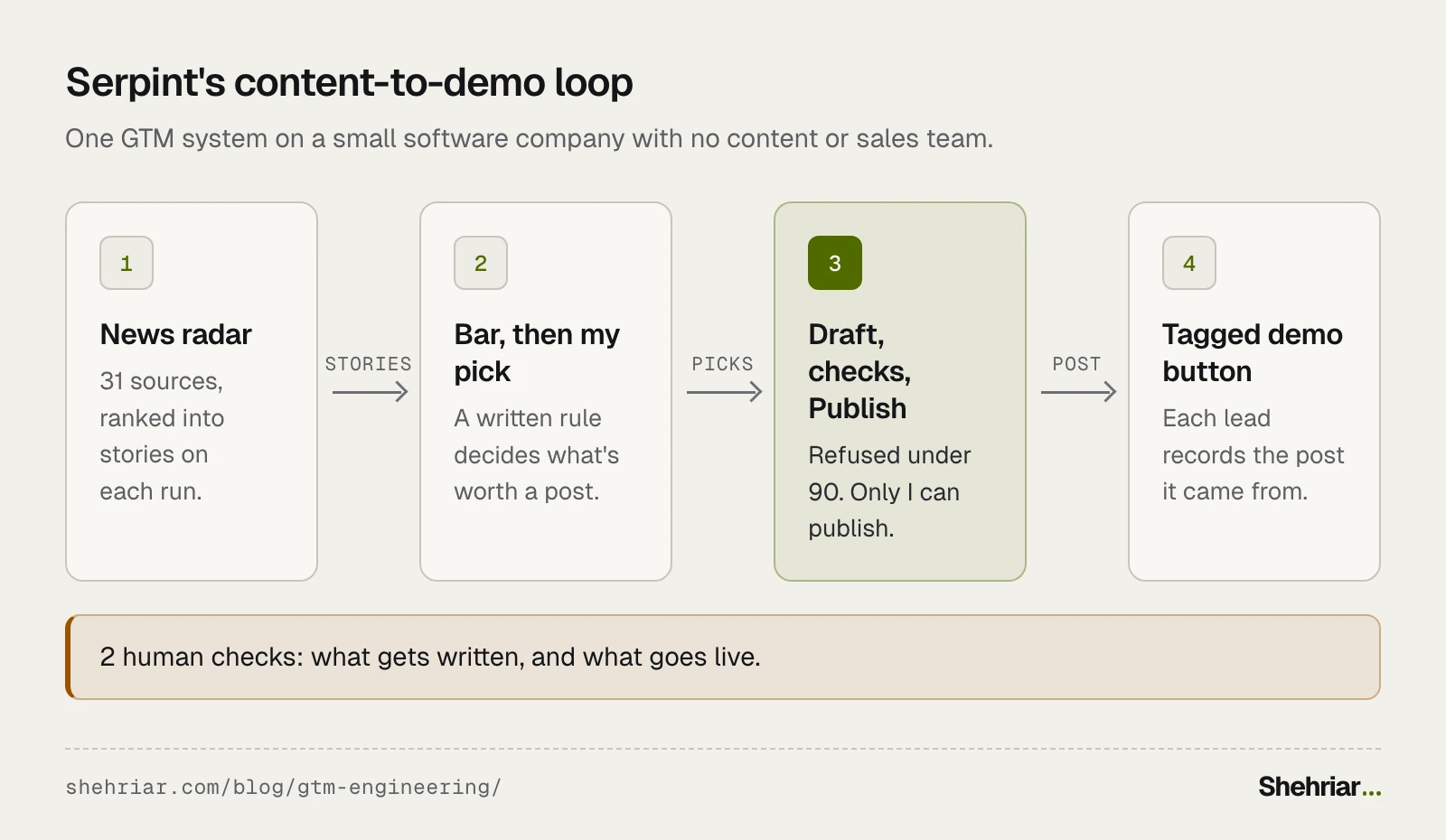
Trigger and data: a radar of 31 news sources#
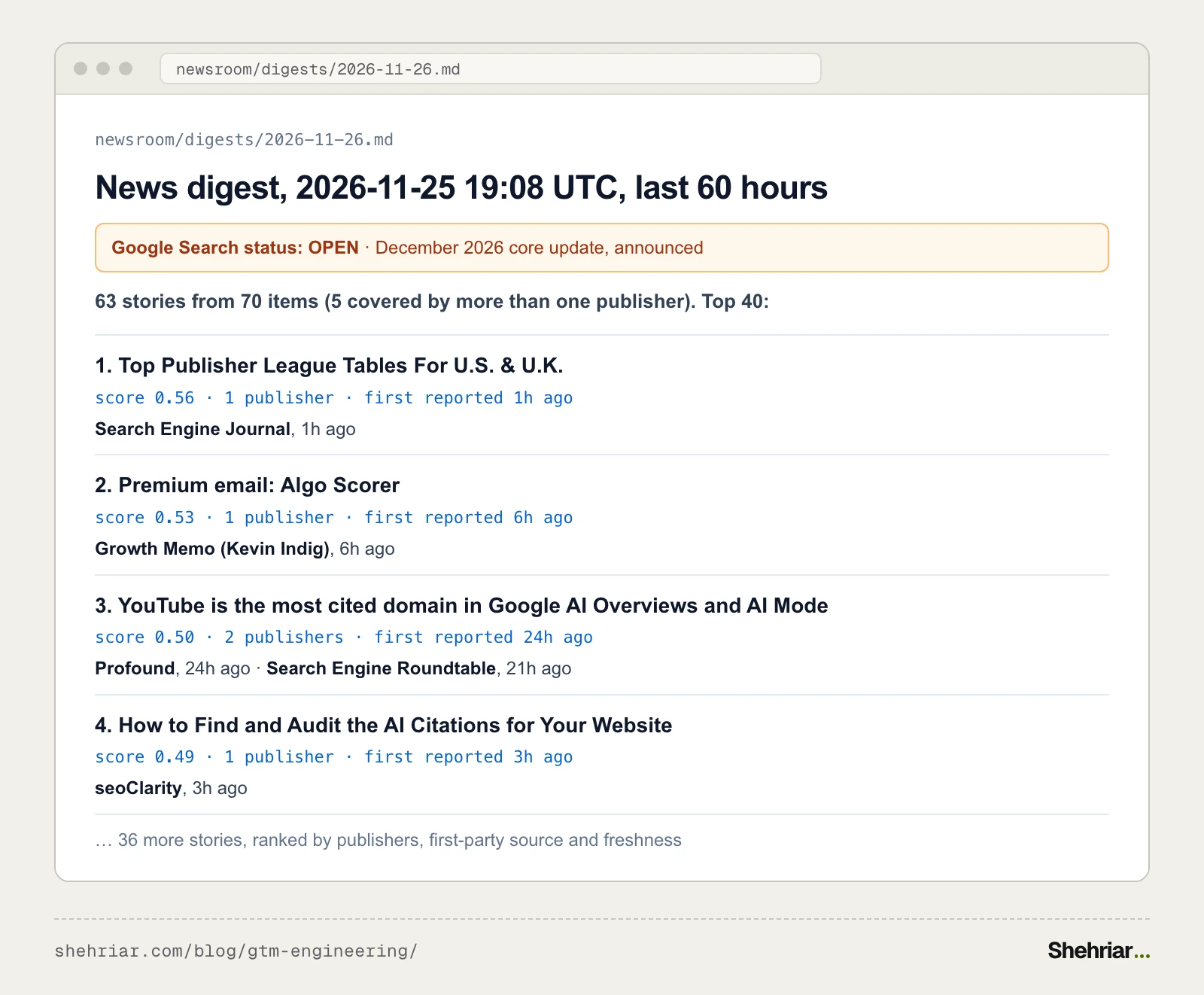
I start a run every few days. First, a small script checks 31 SEO and search news sources for new headlines.
It groups them into stories and ranks them.
A story ranks higher when several publishers cover it, when it comes from Google itself, and when it's fresh.

Rule and human check: a written bar, then my pick#
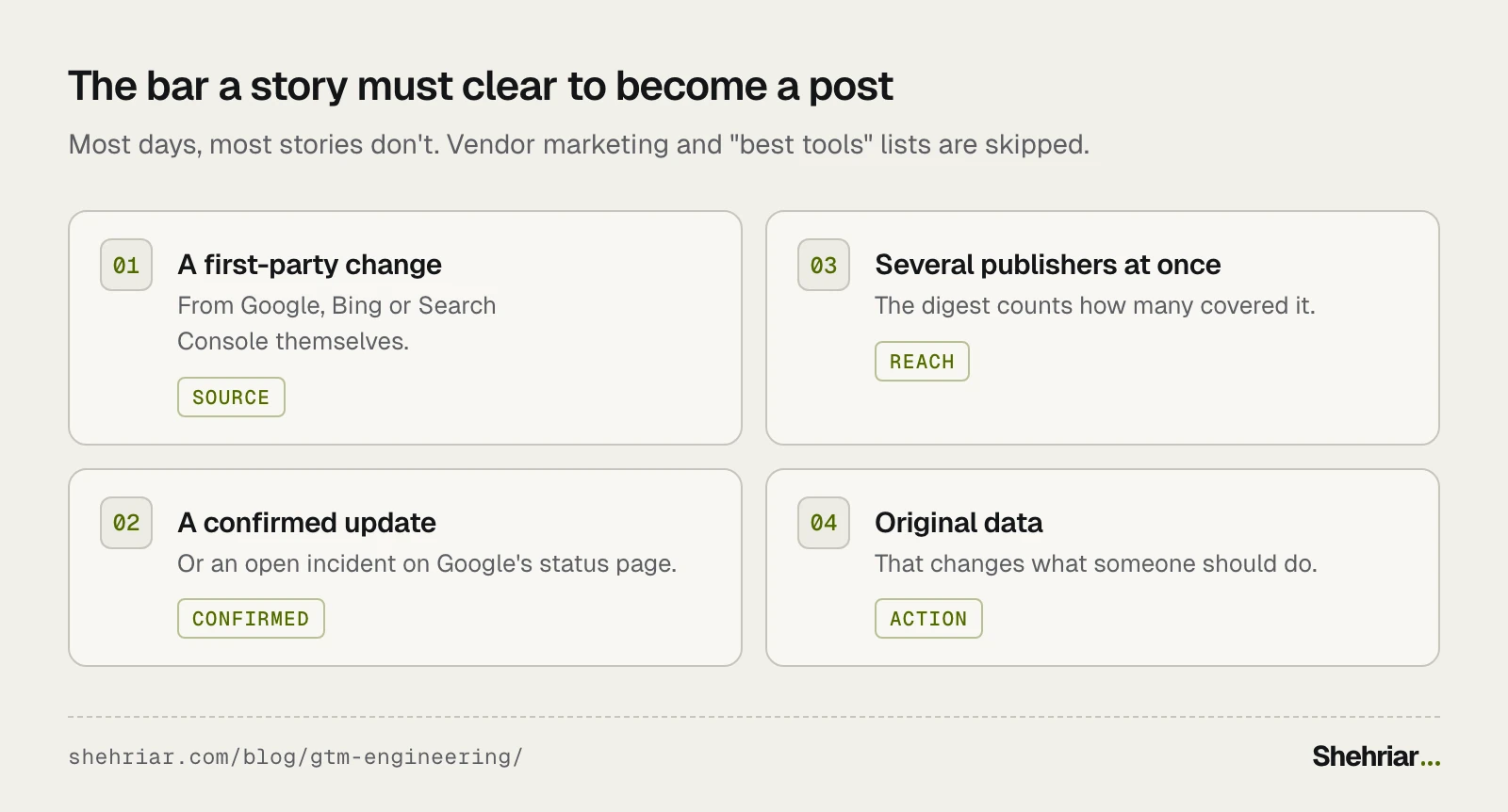
A story only becomes a post if it clears a written bar. Most days, most stories don't.
- A first-party change, from Google, Bing or Search Console.
- A confirmed update, or an open incident on Google's status page.
- Something several publishers cover at once.
- Original data that changes what someone should do.
Vendors' product marketing and "best tools" lists are skipped. So is anything already covered, unless there's real news.
That bar is the system's quality control. Without one, automation just publishes more noise, faster.
The run proposes the stories that cleared it, and I pick. On November 26, my whole reply was "Write N1, N2, N7".
Action: research with its own data, then a draft#
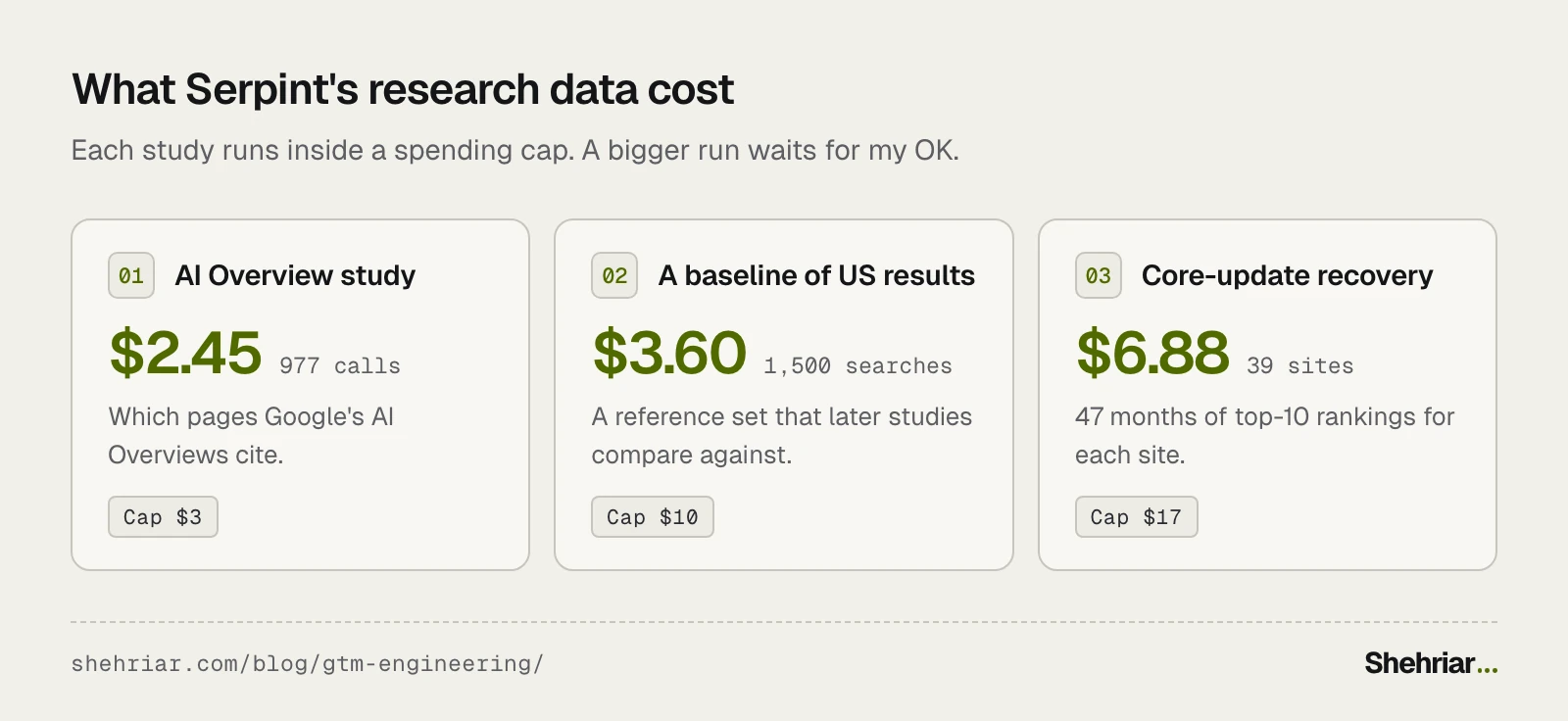
Where it helps, a post adds its own data, pulled from Google's results through DataForSEO.
Every research job has a spending cap. A bigger run waits for my OK.
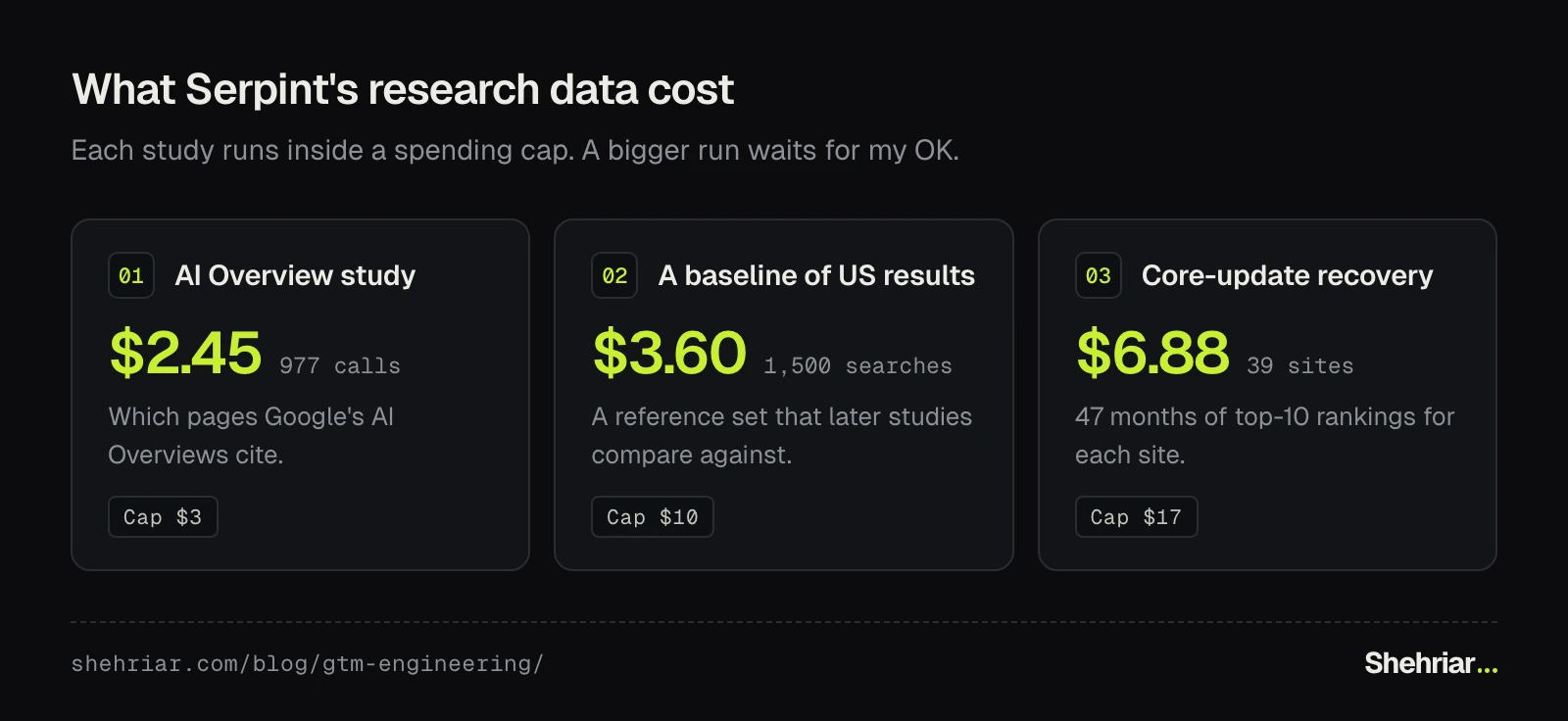
Then it writes the draft, with its charts, sources and a review note for me.
Human check: incomplete drafts can't be published#
The draft goes into Serpint's app, which runs the same checks customers' drafts get. They score the structure, writing and links out of 100.
Publishing is refused under 90, or if anything is missing. That means a description, a cover, a figure with alt text, sources or a review date.
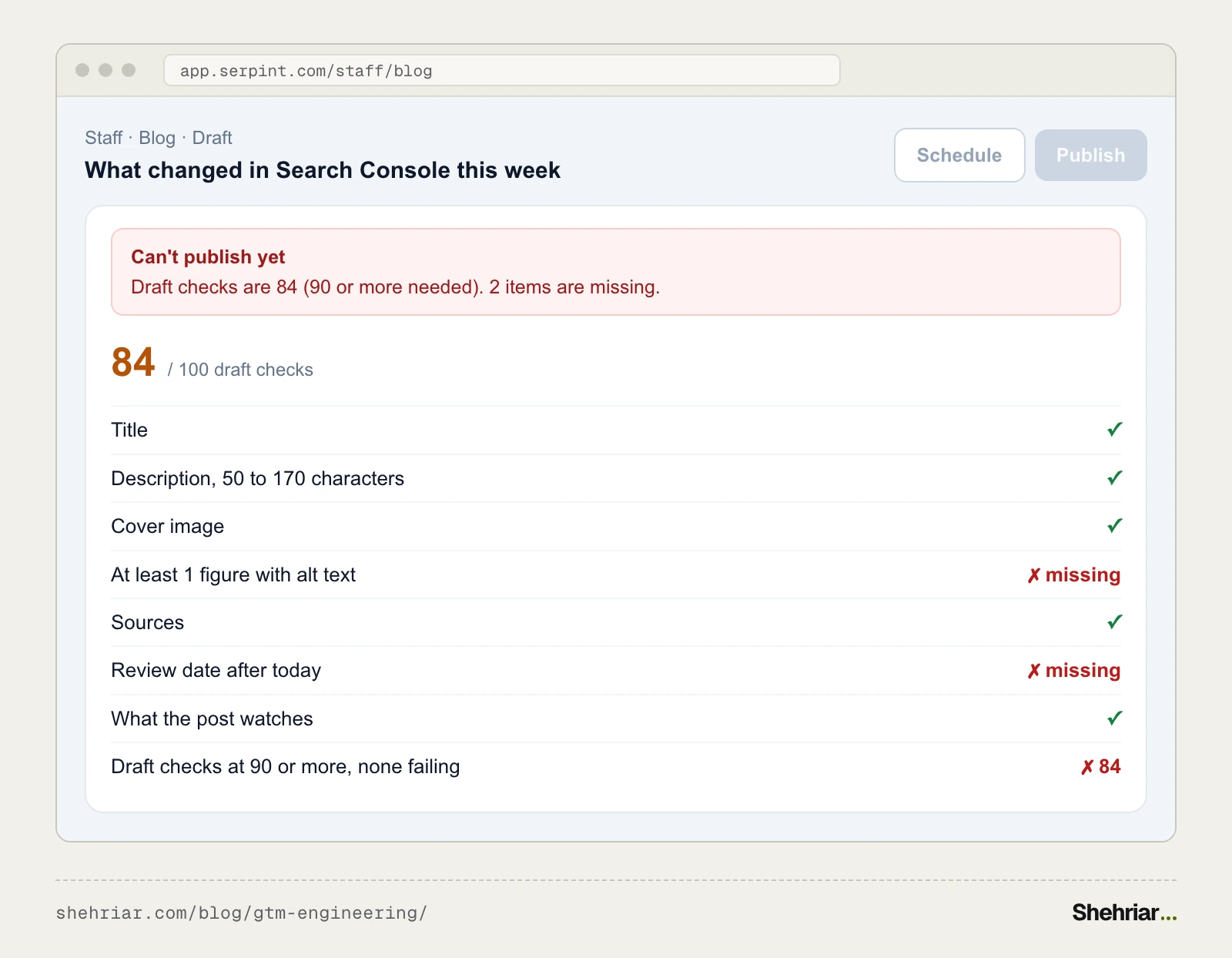
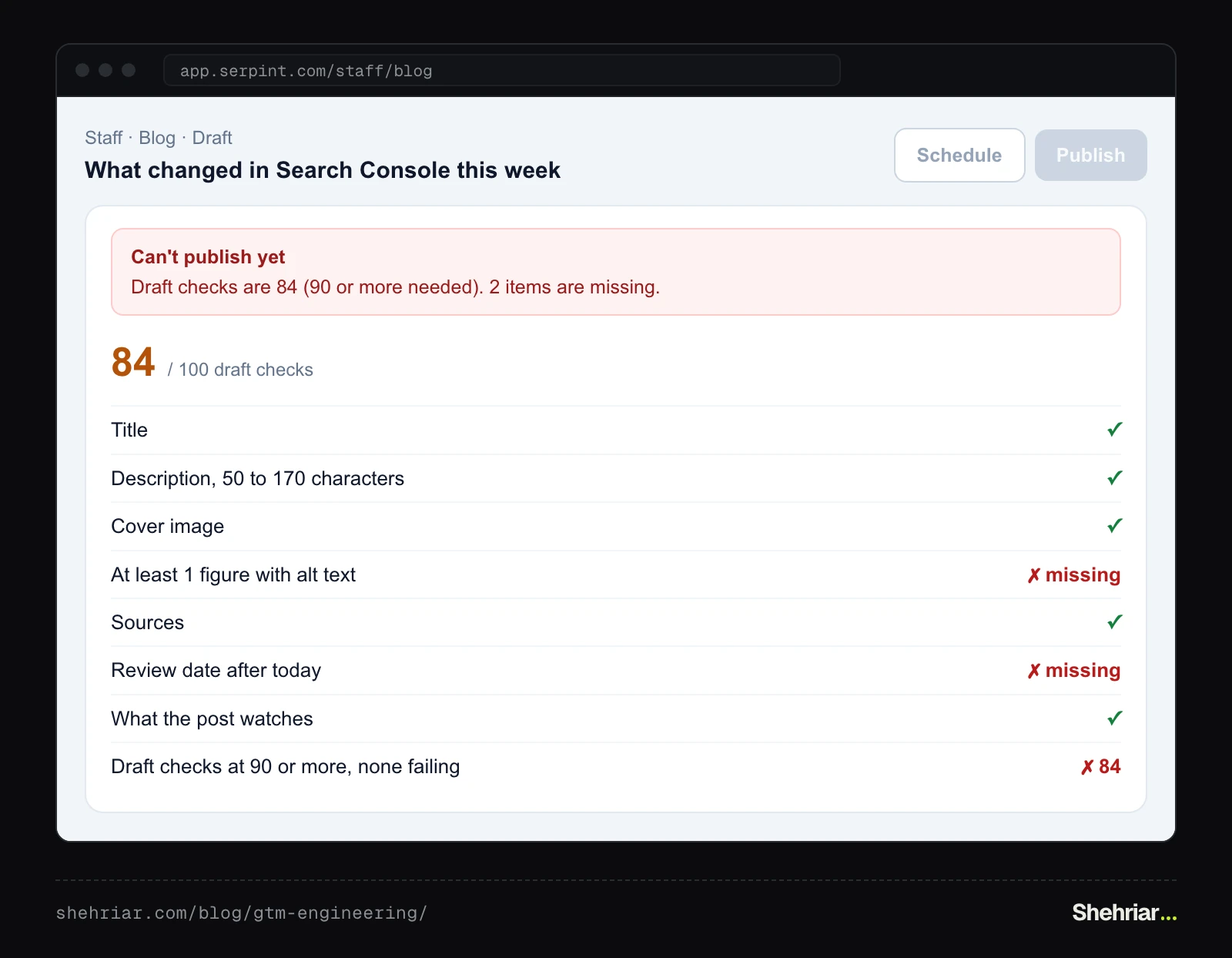
The checks catch what's missing, not what's wrong.
That part is mine. The run can only write drafts, and I read each one before I press Publish.
Record: every demo button knows its post#
Serpint sells by demo for now. Every sign-up button in a post becomes "Request a demo", and keeps the post's UTM tags.
So each lead records the post it came from. The form drops bots and refuses throwaway emails.
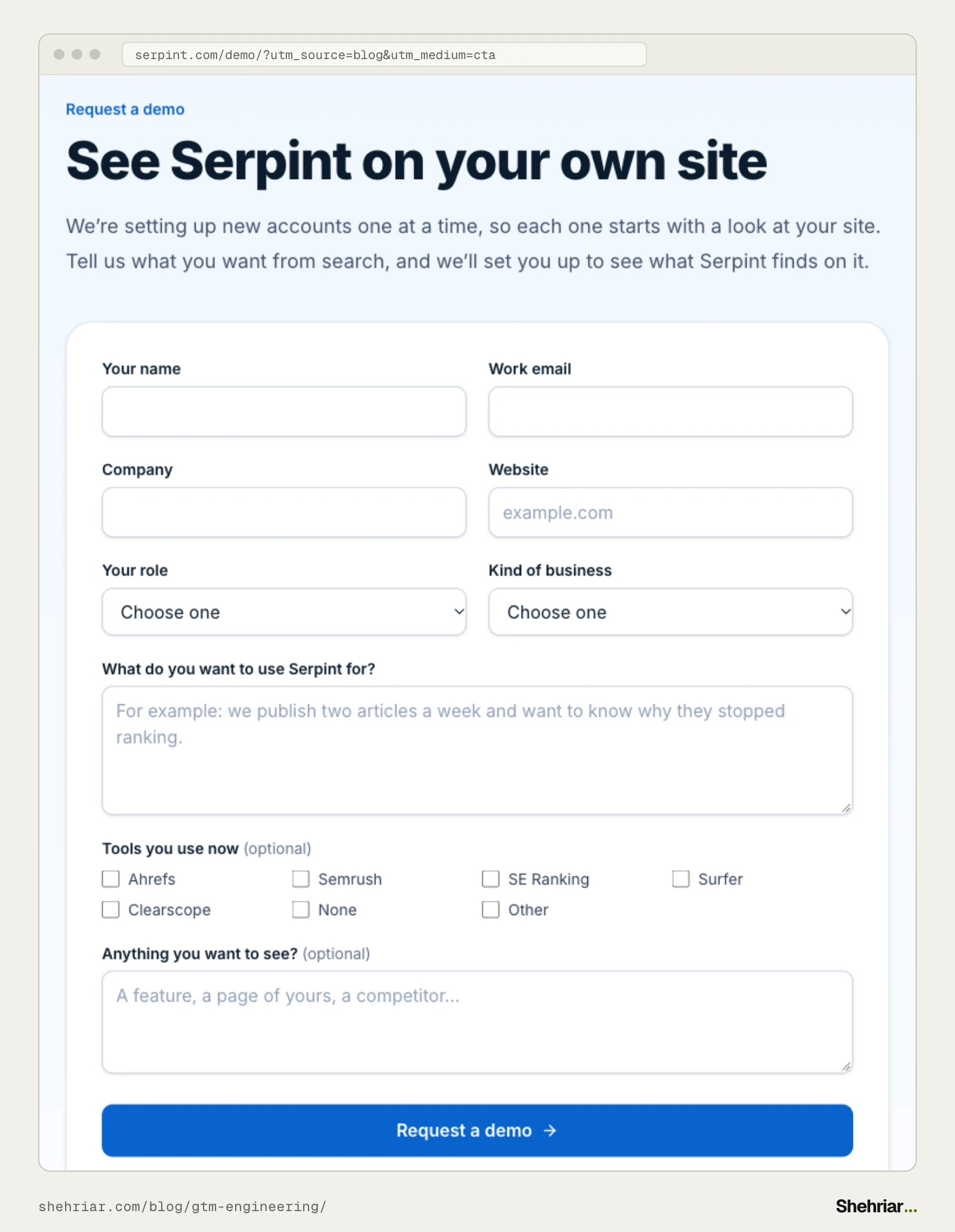
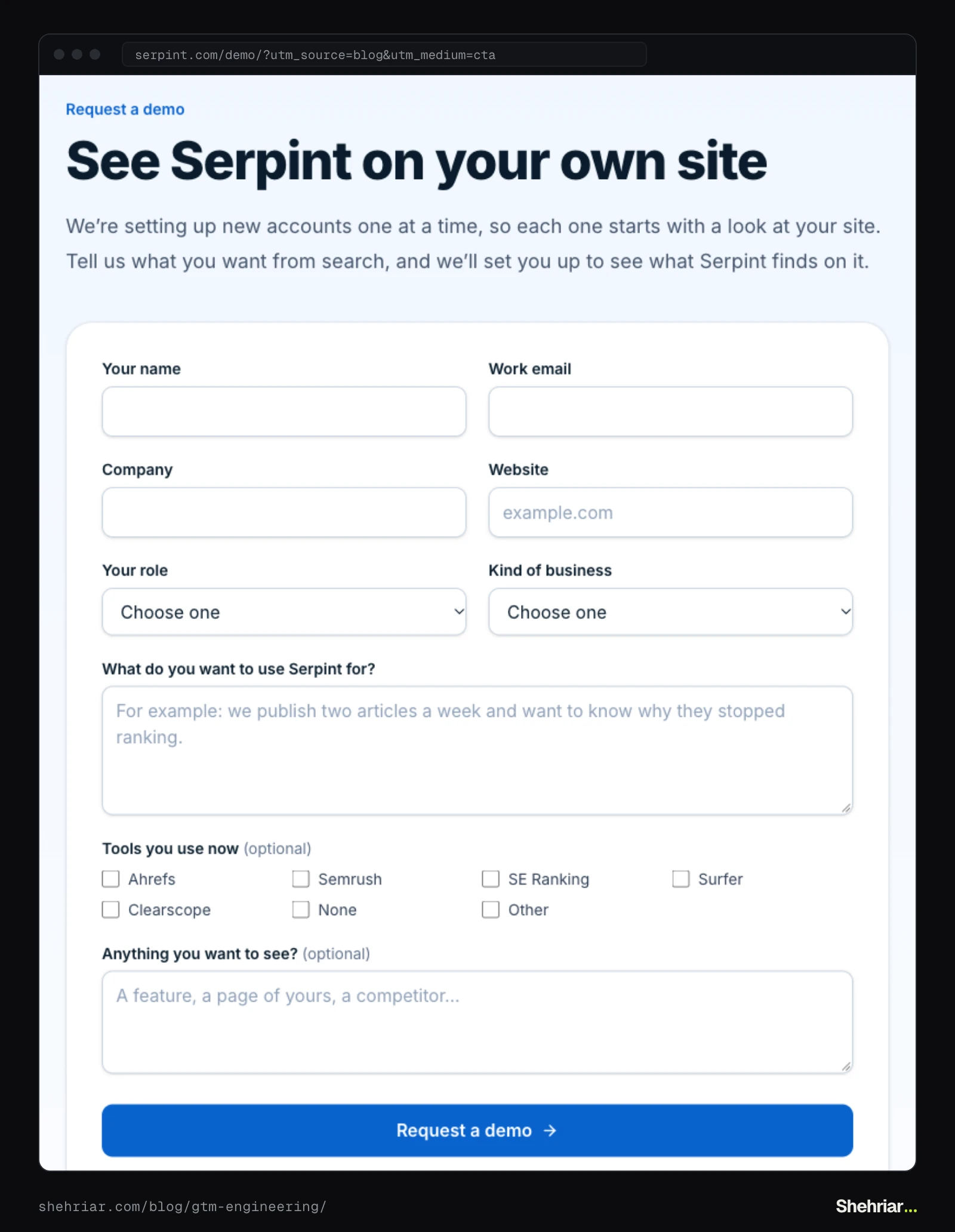
I answer each lead by email, by hand. At this volume, a person replying beats any sequence.
That's a choice, not a gap. When leads arrive faster than I can answer them, that step becomes the next system.
What broke?#
Until November 12, the first 3 posts weren't in the sitemap. The check that read each post's status missed the quotes around it.
Nothing errored. The posts were live, and the system looked healthy.
That's the sneakiest kind of failure: the job runs, but its output never lands.
So test that the end result exists, not just that the job finished.
What does it cost, and what does it prove?#
The first version took 3 days, November 11 to 13, on top of Serpint's existing app. Research data costs a few dollars a study.
What I still do by hand: pick the stories, read every draft, press Publish and answer each lead.
In its first 15 days, it published 18 posts: 15 news, 2 guides and 1 research study.
That proves it can produce. It doesn't prove it wins customers yet.
It's too early for lead numbers. And I didn't time the old way, so I won't claim hours saved.
That's the honest state of most new systems. It's why the record part goes in on day 1.
How would you copy it?#
You don't need Serpint's setup. You need the same 6 parts on the job that leaks in your business.
Here's how I'd set up 2 common ones.
| Part | Agency: quote follow-up | E-commerce: abandoned checkout |
|---|---|---|
| Trigger | A quote is sent | A checkout starts and isn't finished |
| Data | Quote value, service, date sent | The cart, and the customer's past orders |
| Rule | No reply in 2 days: a reminder. 7 days: a call | Wait 1 hour. Skip anyone who ordered. Stop after 2 emails |
| Action | A short follow-up from your own inbox | A reminder that shows the cart |
| Human check | You approve the first 20 before it runs alone | You sign off the copy and any discount rule once |
| Record | Where the inquiry came from, and won, lost or why | Orders from the flow against a holdout group that gets no email |
The store version may need no builder at all. Shopify can email abandoned checkouts automatically. The holdout group is the part you'd add.
Without it, a cart flow takes credit for orders that would have happened anyway.
Do you need a GTM engineer yet?#
Probably not a full-time one. Start with Brendan Short's test.
Do you have a playbook that works today, even if it's manual? If yes, a GTME can scale it. If no, you have a strategy problem, not a GTME problem.
Then check the other 4 conditions. You're ready to build when all 5 are true.
- Something works by hand. You can name the steps that win a customer.
- Volume is breaking it. Leads wait, quotes go unchased, lists go stale.
- You know who you're for. An ideal customer profile you can check, not a persona.
- The data exists. A CRM, a store, or an inbox with history in it.
- Someone will own it. A system nobody owns breaks quietly.
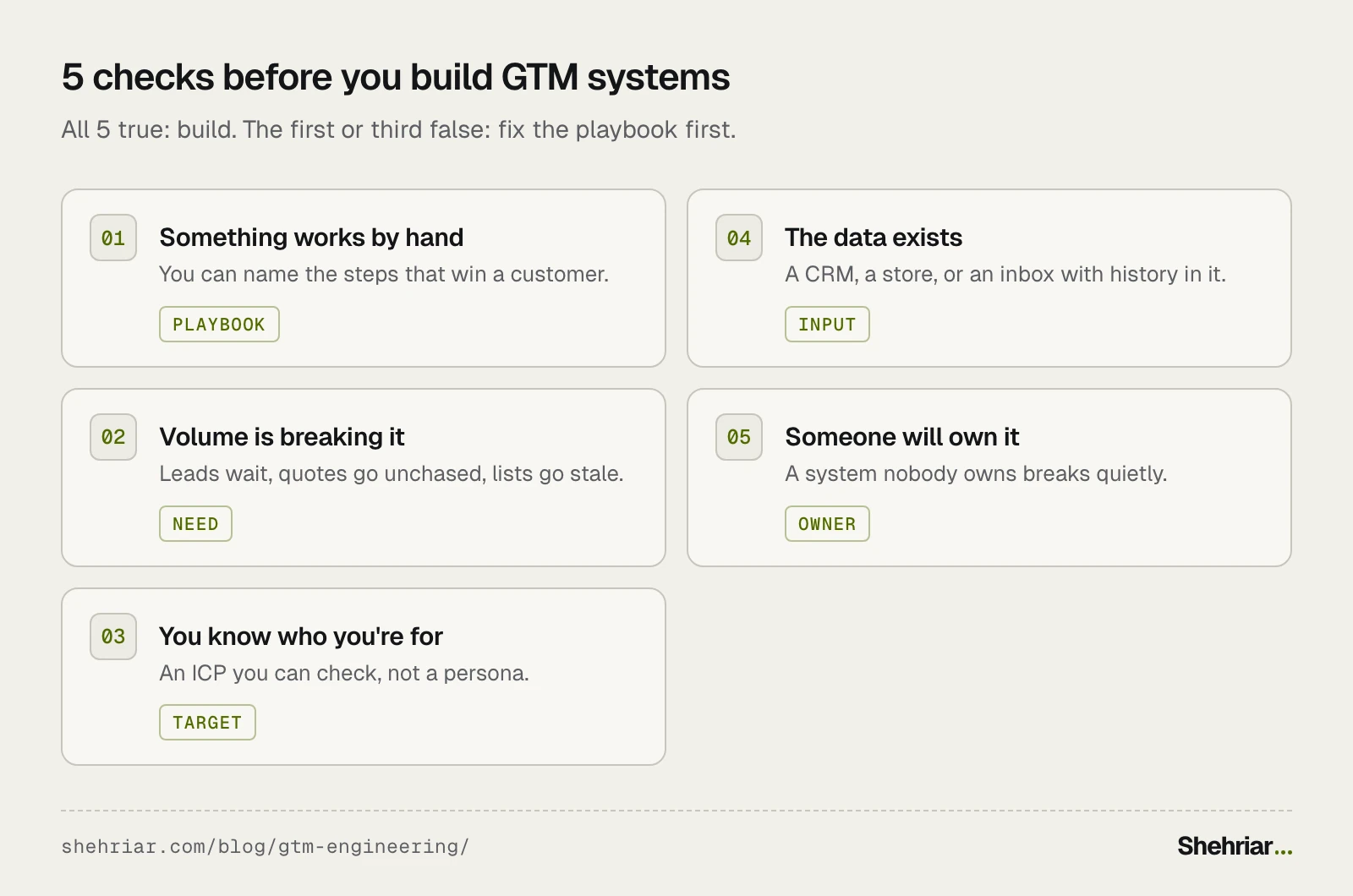
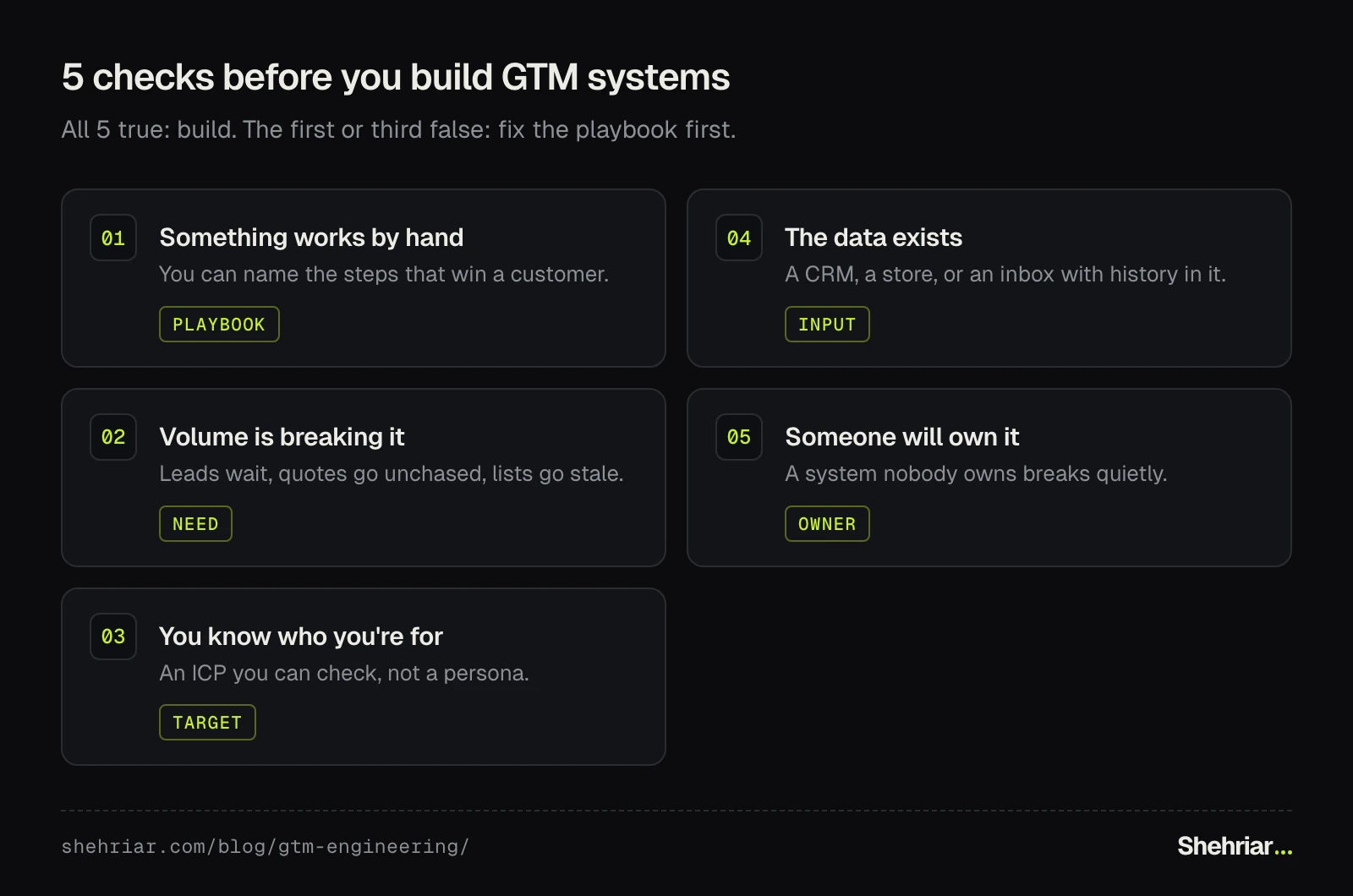
Fail the first or third? Fix the playbook first. Systems scale what you already have, good or bad.
Even with all 5, don't build when your tools already do the job. Or when doing it by hand takes minutes a week.
Volume usually breaks follow-up first. In Workato's test of 114 B2B companies, more than 99% didn't reply to a lead within 5 minutes.
Those without a lead routing tool took nearly 13 hours on average. Those with one still took 3 hours and 32 minutes.
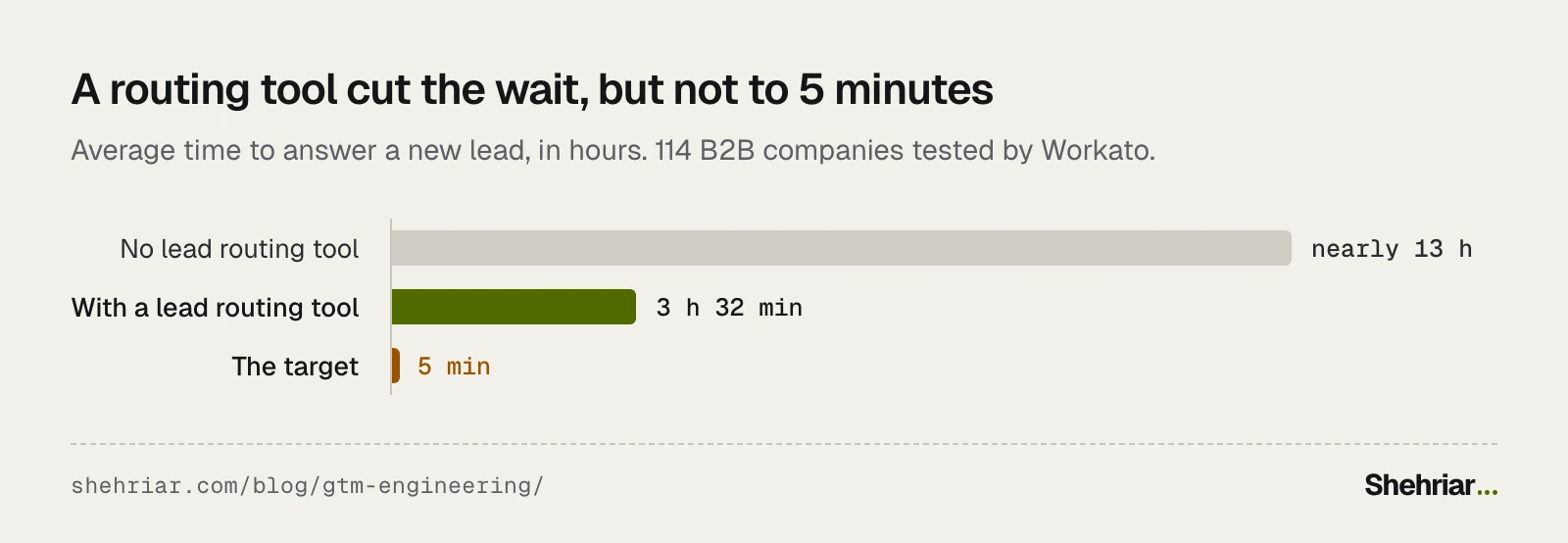
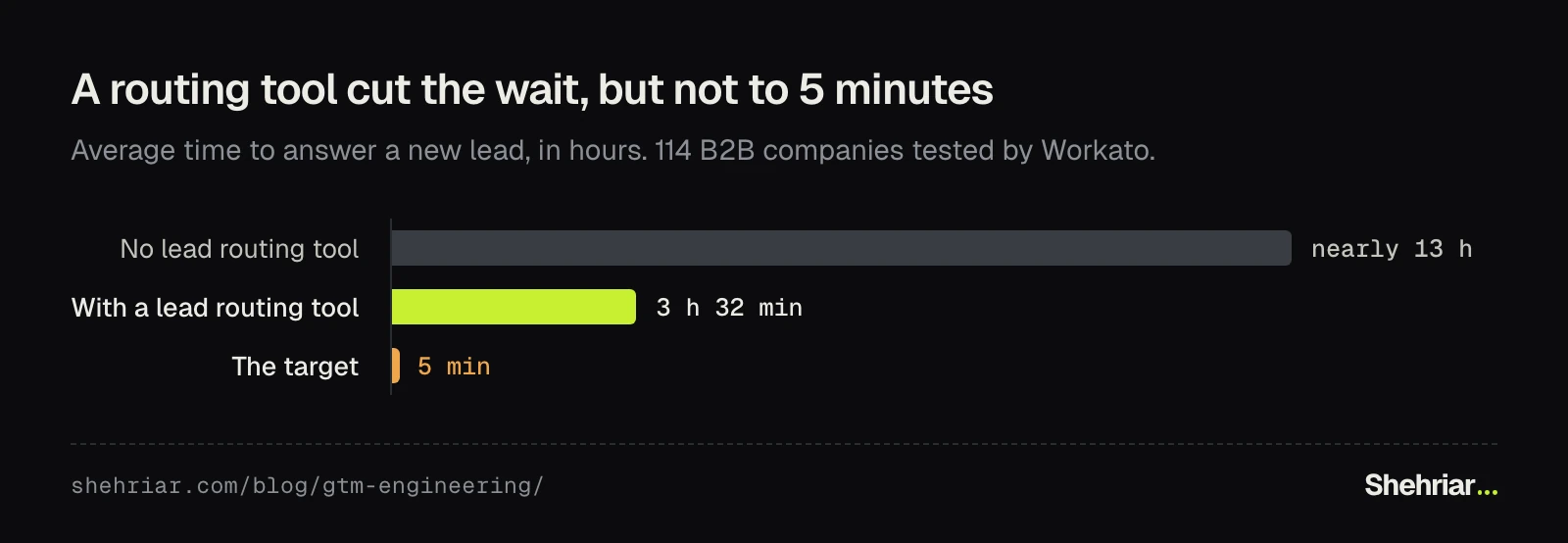
So a tool alone doesn't guarantee speed. Who answers, by when, and what happens after hours matter as much.
Is a GTM system worth paying for?#
Work it out before you talk to anyone, me included. You need 4 numbers.
- Extra wins a month the system should bring. Guess low.
- Profit per win, after the cost of doing the work.
- Running cost a month: tools, data and someone's time to check it.
- Build cost, once.
Monthly benefit is extra wins × profit per win, minus running cost. Payback is build cost ÷ monthly benefit.
Here's an invented example. An agency gets 40 inquiries a month. A quote follow-up system wins 2 more jobs a month, at $500 profit each.
That's $1,000 a month. Take off $100 of running cost, and it nets $900 a month.
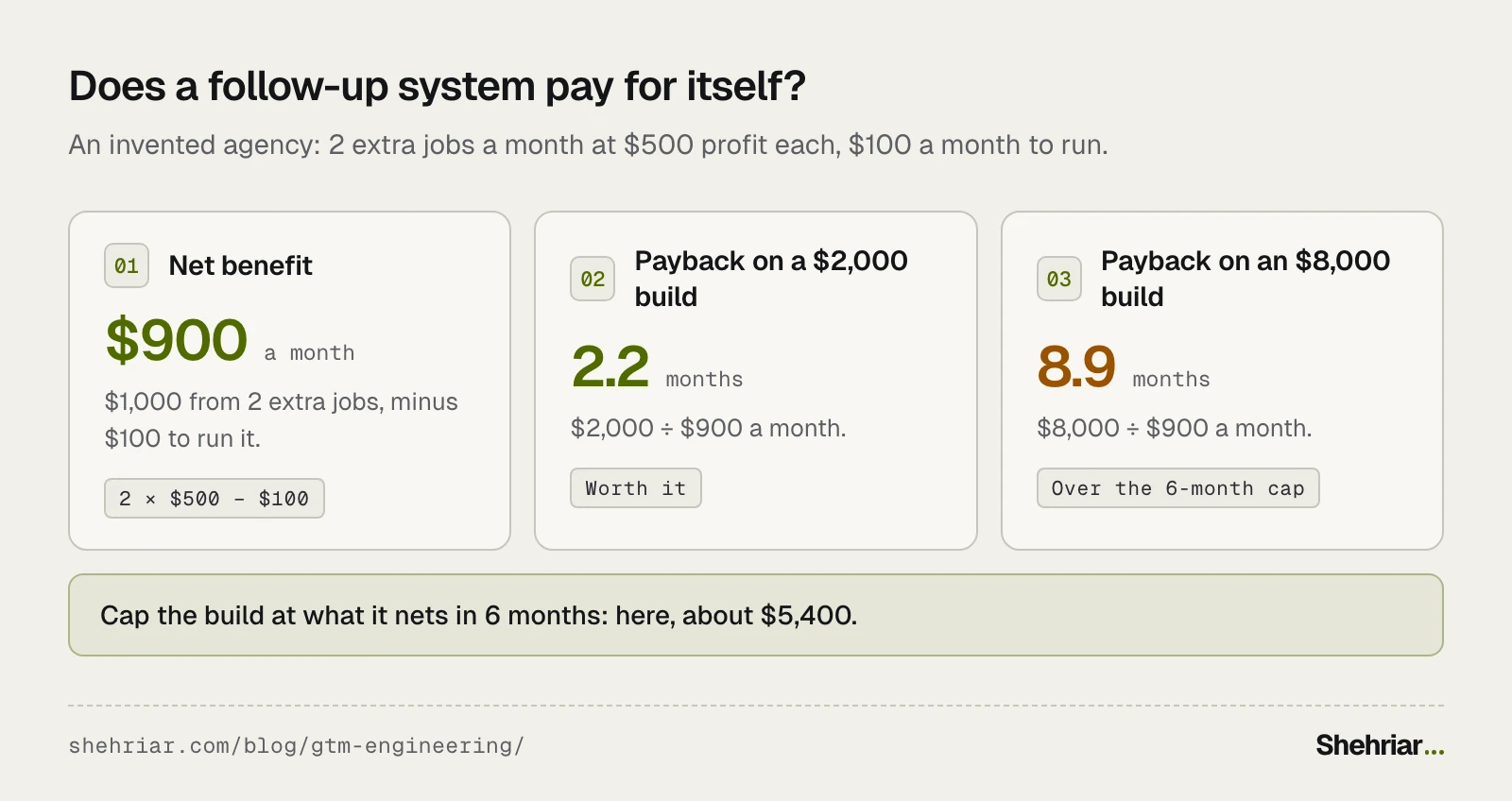
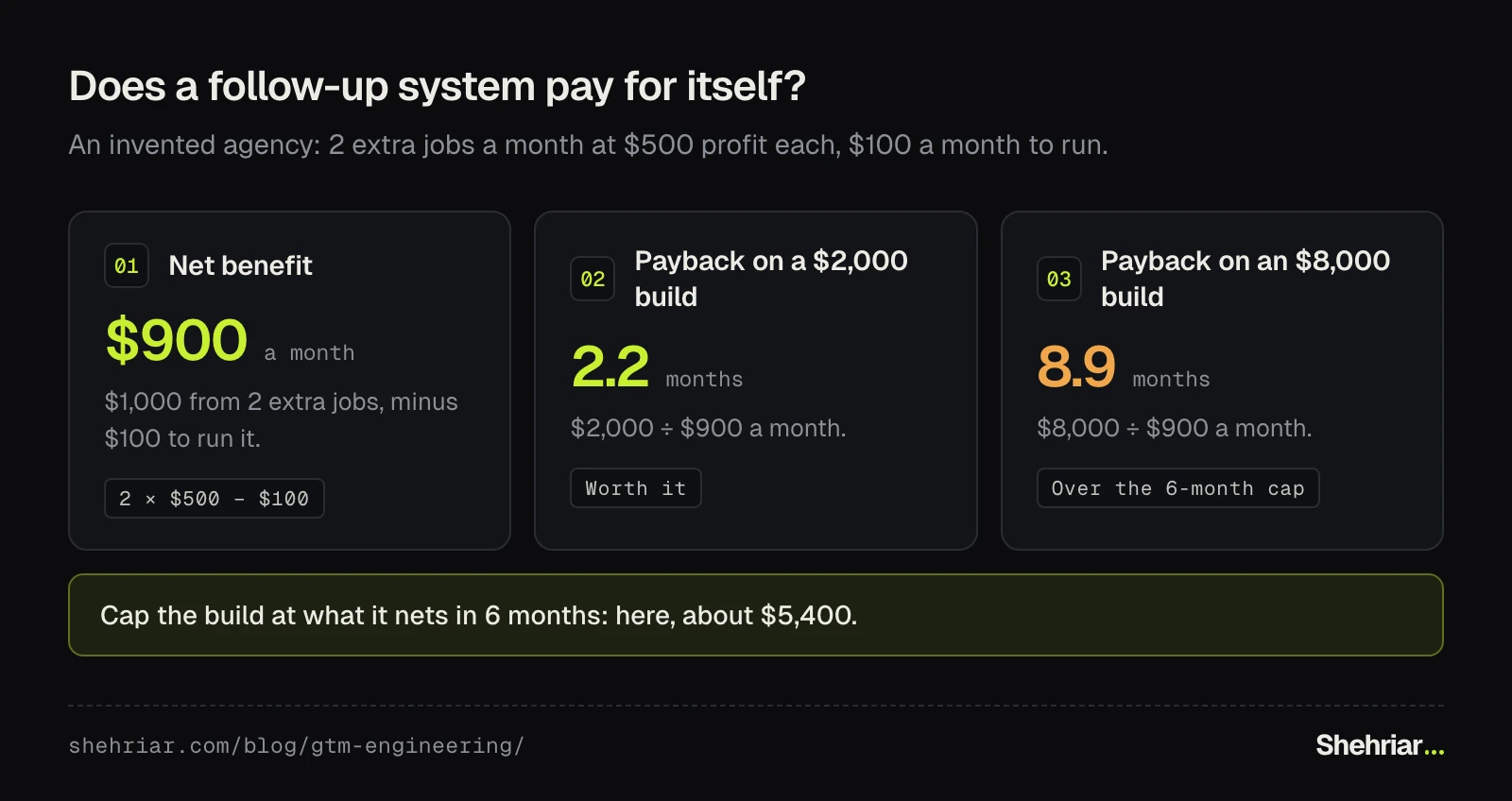
Built for $2,000, it pays back in about 2 months. Built for $8,000, it takes about 9.
My rule: cap the build at what the system nets in its first 6 months. Here, that's about $5,400.
Past that, tools change and the payback is a guess.
Then measure the real number. That's what the record part is for: a holdout group, or the same months compared before and after.
Should you hire, outsource, buy a tool or wait?#
It depends on how many hours of work there are. Here's what each option costs, from pages that name a price.
| Option | What it costs | Fits when | The catch |
|---|---|---|---|
| Wait | $0 | You have no working playbook yet | The founder does it by hand meanwhile |
| Use what you have | $0 extra | Your store or CRM already has the feature, like Shopify's checkout emails | It stops where the tool stops |
| Build it yourself | Tools: n8n from €20 a month billed yearly, Clay from $185 a month | 1 simple system, and someone who can build | Only you understand it |
| Freelancer | $20 to $118 an hour in my Upwork search. A 10 to 30-hour job is $200 to $3,500 at those rates | 1 clear system | It leaves with them unless they hand it over |
| Project | $8,000 to $15,000 for a scoped build at Jinn | Several systems that need designing together | Check the payback first |
| Fractional | $4,000 to $12,000 a month for 1 to 2 days a week (Kiin) | A steady stream of work, but not a full week | The same handover risk |
| Agency | From $4,000 a month, often plus ad spend (Kiin) | You want it built and run for you | It works toward whatever you pay it for |
| Full-time hire | $159,000 median salary in 509 US job posts (Cargo), plus tools | A queue of work for the next year | Hard to judge a hire before you've built one |
Bloomberry's count of job posts puts the median salary lower, at $127,500. Most of these numbers come from companies that sell one of the options.
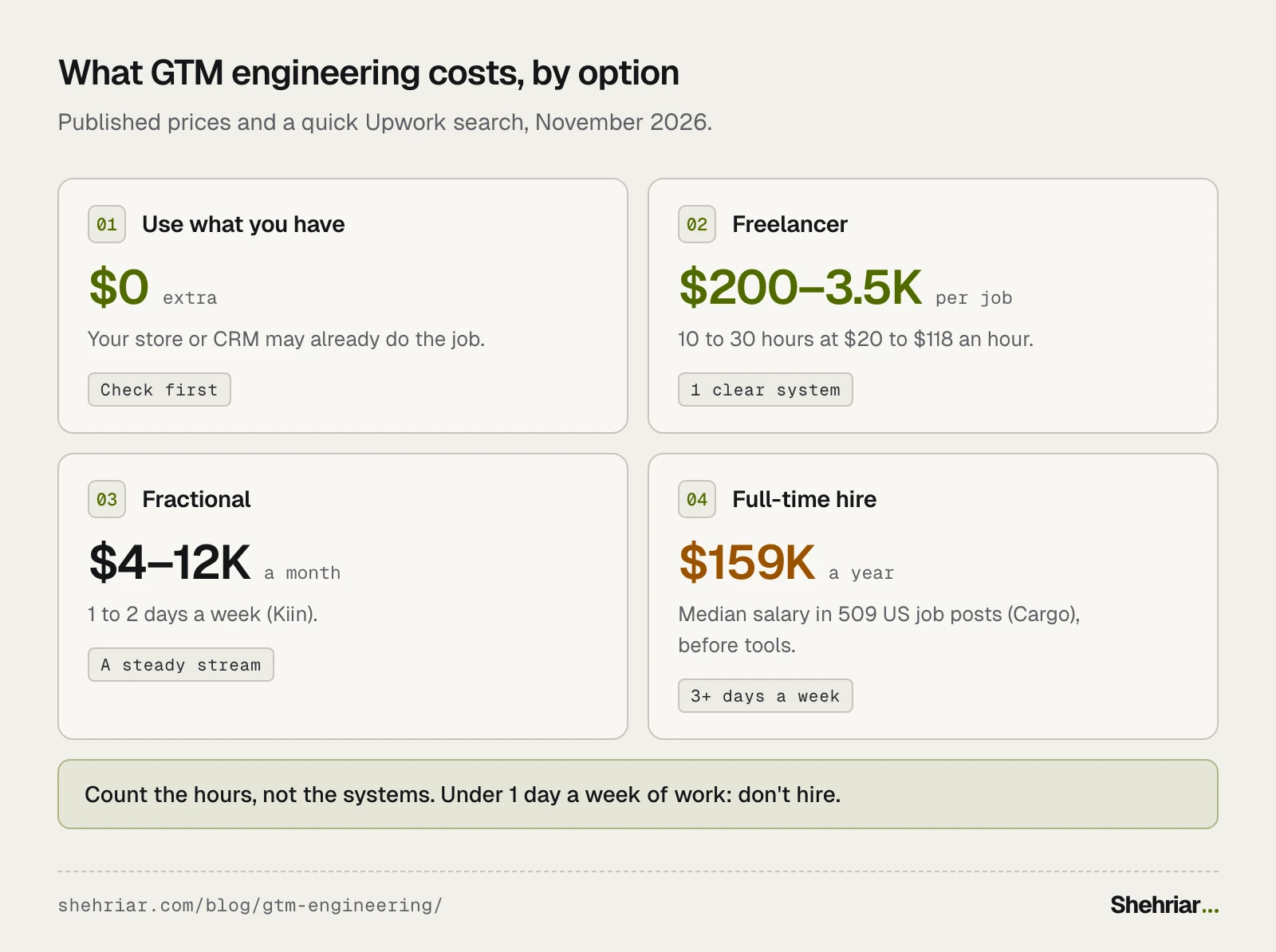
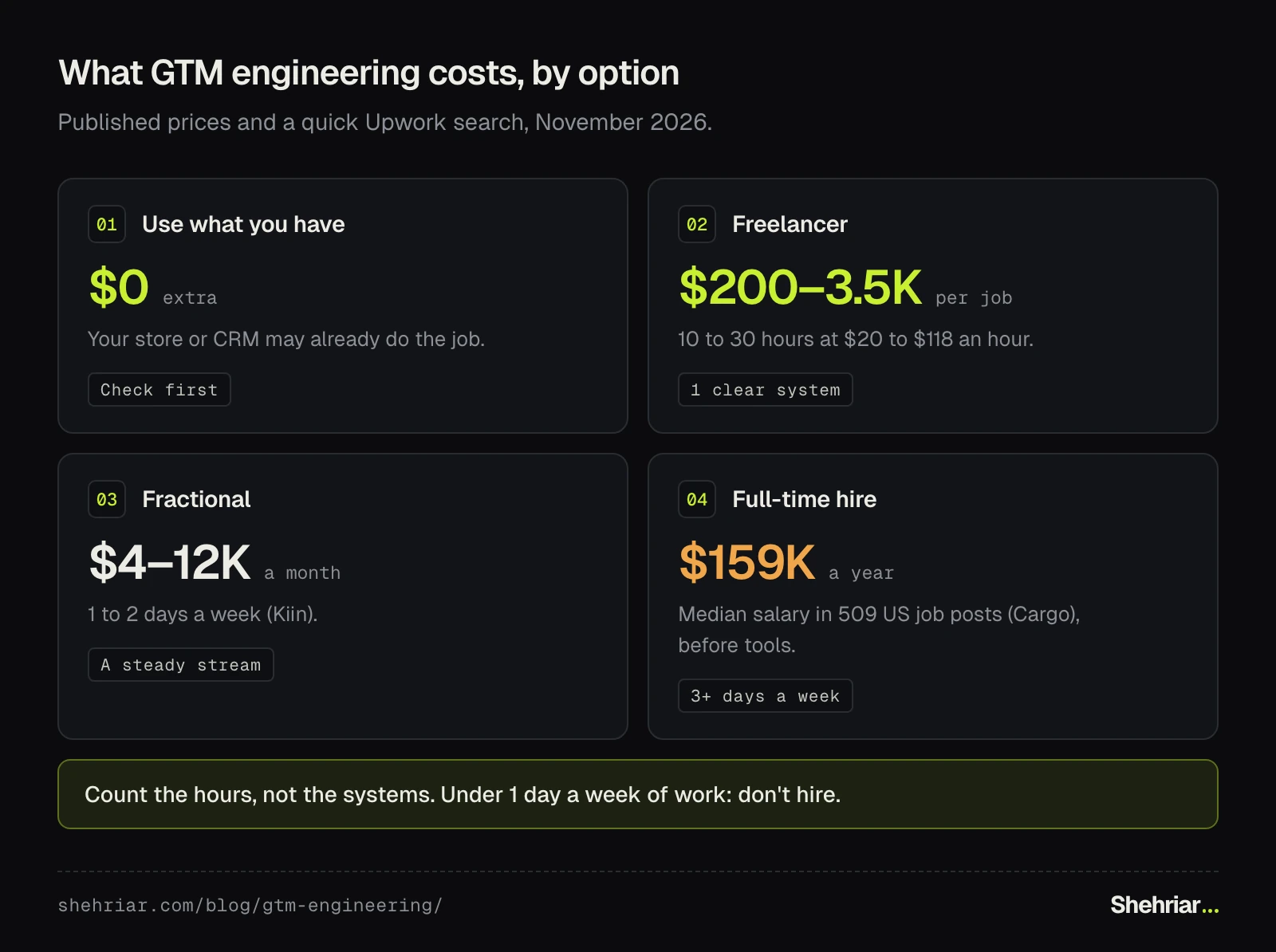
Count the hours, not the systems.
3 small flows might take a day each. 1 system that crosses 4 tools might take weeks, then need care every month.
- Under 1 day a week of building and upkeep: a freelancer or a project.
- 1 to 2 days a week, for months: a fractional engineer. That's what the fractional prices buy.
- 3 or more days a week, for the next year: a full-time hire starts to make sense.
At the median salary, a hire costs about $13,000 a month before tools.
That's the top of the fractional range, every month, whether there's work or not.
Clay argues the opposite: hire a GTM engineer before your first salesperson.
That fits an outbound-heavy software company with data to work. For a 5-person agency, it's an expensive answer to a follow-up problem.
What should you ask a builder for?#
Whoever builds it, the system should stay yours when they leave. Ask for these before you pay the last invoice.
- Accounts and keys in your name, not theirs.
- A diagram of the 6 parts, and which tool runs each one.
- A test log: what they tried, on which records, and what failed.
- Alerts that reach a named person when a step fails.
- A recorded handover call, so the next person can pick it up.
To judge a builder before that, pay for a trial day on your real setup. Arda, a startup backed by Stage 2 Capital, did this.
In 1 day, its finalist found a lead lost to a broken field mapping. And a list where about a third didn't fit.
What goes wrong when GTM systems are built badly?#
4 things come up again and again. Each has a first line of defense.
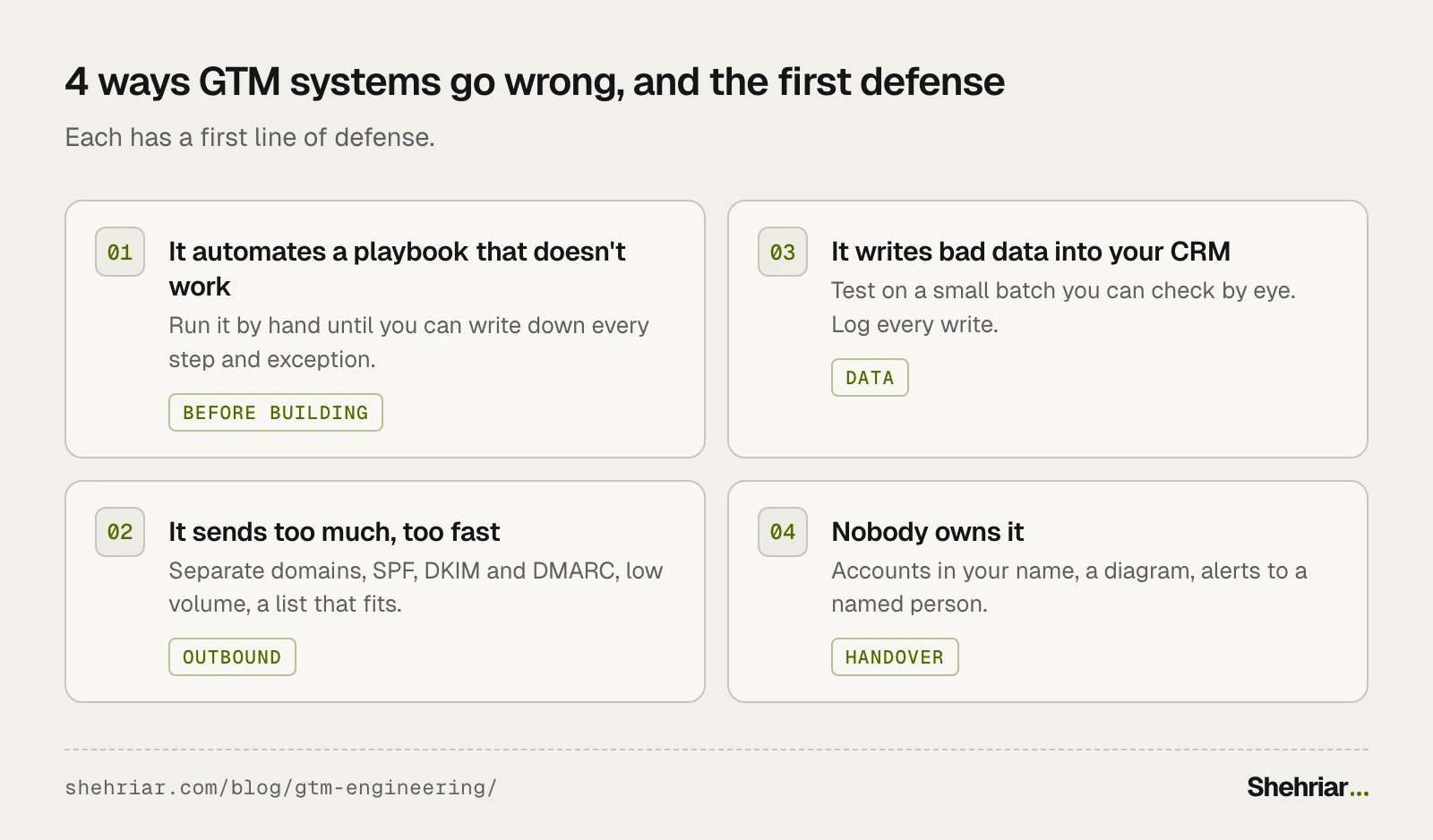
It automates a playbook that doesn't work. A broken process just breaks faster.
The defense: run it by hand until you can write down every step, and every exception.
It sends too much, too fast. Cold email from your main domain can drag all its email into spam. Invoices too.
The defense: separate sending domains with SPF, DKIM and DMARC set up, an easy unsubscribe, and low volume at first.
Even then, relevance decides most of it. A list that fits your ICP draws fewer spam complaints than any setting can save.
It writes bad data into your CRM. A wrong field mapping overwrites good records or drops leads.
The defense: test on a small batch you can check by eye. Log every write, and never overwrite what a person typed.
Nobody owns it. The freelancer leaves, a step fails, and nobody notices for weeks.
The defense: the handover list above, alerts included. My sitemap miss was this problem at a small scale.
Where do you start?#
With a list, not a tool. Spend 30 minutes with whoever handles sales and customers, and fill this in.
| Job done by hand | How often a month | Time each | What's lost when it's missed | Tool that touches it |
|---|---|---|---|---|
| Reply to a new inquiry | 40 | 10 min | The job goes to whoever answered first | Inbox, CRM |
| Chase a sent quote | 25 | 5 min | Quotes go cold | Inbox |
| Your next job here |
The first 2 rows are examples.
Pick the row with the biggest loss you can put a number on, and run it through the payback math.
For most businesses, that row is follow-up:
- Software or SaaS: answering demo requests and good signups within minutes.
- Agency or service business: replying to every inquiry fast, and chasing every quote on a schedule.
- E-commerce: a checkout reminder with a holdout group, then reorder reminders timed to how long your product lasts.
Whatever you build, add the record part on day 1. Without it, you can't tell whether the system made money or just made noise.
Want help picking the first system?#
If you'd like a second pair of eyes, send me your list.
I'll tell you which row to build first, what it should cost, and whether you need anyone to build it.
FAQ#
What does a GTM engineer do?
A GTM engineer turns manual sales and marketing jobs into systems. That means building lead lists, watching for buying signals, scoring and routing leads, automating follow-up, tracking where customers come from and keeping the CRM clean.
How much does a GTM engineer make?
The median US salary was $159,000 in 509 job posts that showed pay, April to July 2026 (Cargo). Bloomberry's count of job posts gives a median of $127,500. Fractional GTM engineers charge about $4,000 to $12,000 a month for 1 to 2 days a week.
Is a GTM engineer the same as RevOps?
They overlap a lot. Bloomberry found 9 of the top 10 GTM engineer duties in RevOps engineer job posts too. RevOps mostly runs and reports on the existing process. GTM engineering mostly builds new parts of it.
What's the difference between automation and GTM engineering?
Switching on your store's abandoned checkout email is automation. GTM engineering starts when the job crosses tools, needs data you don't have yet, or needs a decision rule your tools can't make on their own.
Do I need Clay to do GTM engineering?
No. Clay is one tool for building lead lists and enriching them. Many GTM systems never touch it, such as quote follow-up, abandoned-cart flows or attribution. Pick the tool after you've written the rule the system follows.
When should you hire your first GTM engineer?
When a playbook already works by hand, volume is breaking it, and you have 3 or more days a week of building and upkeep for the next year. Before that, a freelancer, a project or a fractional engineer is usually cheaper.